
Featured article
A New Era for Alexa Translations
This isn’t a rebrand. It’s a brand evolution.
Read more


For decades, translation has largely been priced around one simple unit: the word.
That made sense when the amount of content a translator could produce in a day placed a natural limit on capacity.
AI is changing that equation.
In a recent episode of Firing On All Syllables, Renato Beninatto, Chairman and Co-Founder of Nimdzi Insights, put the disruption plainly: the translation industry’s pricing model is based on a unit that has “become irrelevant.”
The word.
Word count remains useful for scoping and pricing. But when AI can process enormous volumes in a fraction of the time, volume alone tells us less about the value of the work.
Table of Contents
The traditional translation model was built around a basic constraint: how much a professional translator could produce.
Renato uses a striking comparison. A translator might produce around 2,000 words in a day, while AI can process vastly greater volumes in minutes.
That doesn’t make the word meaningless as a measure of content.
But it does challenge its role as the primary measure of translation value.
If technology dramatically changes the time and resources required to translate content, measuring value primarily by volume becomes harder to justify.
And the industry hasn’t settled on what replaces it.
Renato points to retainers and value-based pricing among the models being explored, describing an industry still working through what translation pricing looks like in an AI-enabled world.
For organizations buying professional translation services, that shift creates an opportunity to think differently about what they’re actually paying for.
AI can make the translation task faster and more efficient. But speed isn’t the only thing that determines the value of the work.
Specialized expertise. Quality. Risk. Security. Consistency. The ability to apply the right technology and level of professional oversight to different types of content.
Those factors don’t disappear as AI becomes more capable. They become a larger part of where the value lies.
Renato sees that shift reaching the executive level as well. He describes conversations moving beyond cost alone toward broader questions of value, deployment and efficiency.
As the economics of translation change, organizations have an opportunity to look beyond volume and evaluate the expertise and outcomes their translation model delivers.
For Renato, that puts a premium on adaptability and expertise:
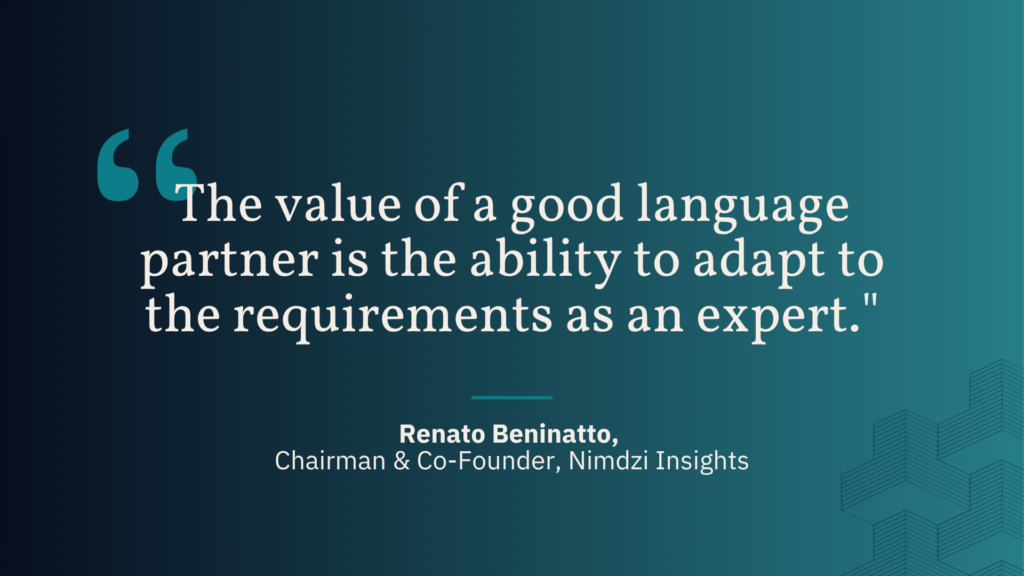
As AI changes the task of translation, the value of a partner increasingly comes from knowing how to apply the right technology, capacity and expertise to the work at hand.
Apertera (formerly Alexa Translations) combines Adaptive AI with more than two decades of professional expertise to deliver the right mix of technology, capacity and expertise based on what the work requires.
Is Your Translation Model Delivering the Right Value?
As translation economics change, understanding how your current resources, technology and workflows are being used is a good place to start.
Download The Translation Capacity Shift: What Canadian Business Leaders Need to Know Now to assess your current approach and identify opportunities to reduce costs, expand capacity and improve access to specialized expertise.
1. How is AI changing translation costs?
AI can reduce the time and resources required for some translation tasks, particularly at higher volumes. However, total translation costs also depend on factors such as complexity, professional oversight, specialized expertise, quality requirements and risk.
2. How should organizations evaluate per-word pricing as AI changes translation?
Per-word pricing remains useful for scoping and pricing translation work. AI is changing the relationship between volume, time and cost, so word count alone may not capture the full value of the work. Organizations should also consider quality, specialized expertise, risk and the level of professional oversight required.
3. What should organizations consider when evaluating professional translation services?
Beyond unit cost, organizations should consider whether their model provides the right combination of technology, capacity, specialized expertise, quality and professional oversight for different types of work.

AI can translate more content, faster than ever before. So translation should be getting simpler. It isn’t. As AI translation becomes more capable, organizations have more choices to…

Efficiency has become one of the defining priorities for legal teams. The 2026 ACC Chief Legal Officers Survey found that 53% of CLOs rank operational efficiency among their…

Legal work rarely arrives in a neat, predictable queue. A contract needs to move today. A regulatory document changes at the last minute. A bilingual colleague gets pulled…
