
Featured article
A New Era for Alexa Translations
This isn’t a rebrand. It’s a brand evolution.
Read more


Efficiency has become one of the defining priorities for legal teams.
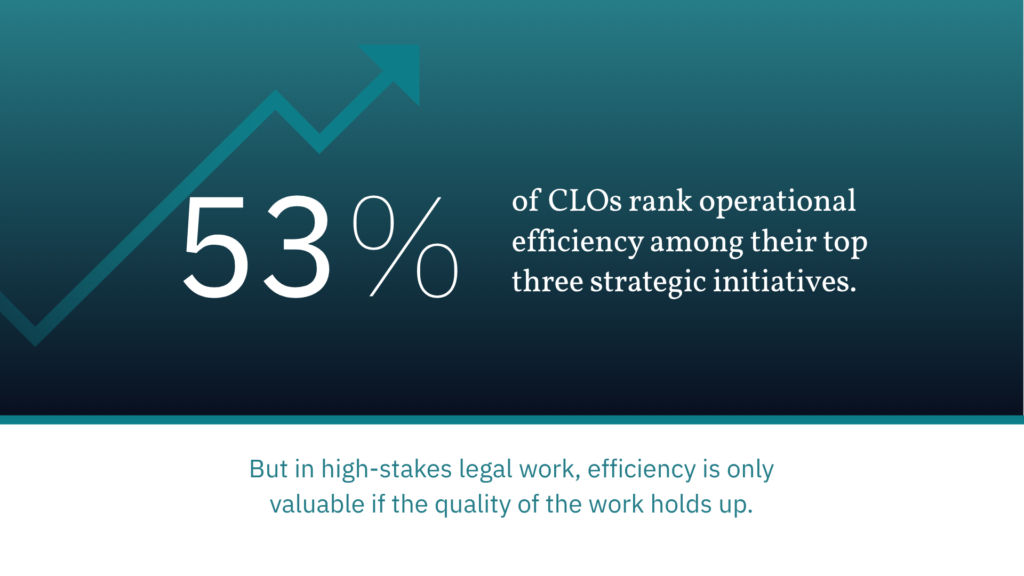
The 2026 ACC Chief Legal Officers Survey found that 53% of CLOs rank operational efficiency among their top three strategic initiatives for the next 12 months, ahead of regulatory compliance and technology implementation.
AI and automation create new opportunities to get there. Routine tasks can move faster. Manual work can be reduced. Internal teams can regain capacity.
But in high-stakes legal work, efficiency is only valuable if the quality of the work holds up.
For multilingual legal workflows, that means finding the right balance between what can be automated, what should be standardized and where professional expertise and oversight still matter.
Legal workflow automation works best when all three are designed to work together.
Table of Contents
Inefficiency doesn’t always look like a broken process.
Often, it’s a series of small manual steps that have become part of the routine. Information gets re-entered. Routine tasks are repeated from one request to the next. Work moves manually between systems and reviewers. Internal teams spend time on coordination that technology could help streamline.
Each step may seem manageable on its own. Together, they consume capacity.
Legal workflow automation can remove some of that friction by standardizing repeatable tasks, connecting information and reducing unnecessary handoffs. But deciding what to automate matters just as much as the technology itself.
High-volume, repeatable work may be a natural fit for automation. Content involving legal nuance, sensitive terminology or greater risk may require a different level of professional review.
The goal is to remove friction without removing the judgment the work requires.
The most effective workflows don’t automate everything. They use AI and automation to accelerate repeatable work, connect technology to the right organizational knowledge, and apply professional expertise based on the complexity and risk of the content.
The real value of a more efficient workflow isn’t simply that work moves faster. It’s what legal teams can do with the time and capacity they get back.
When AI and automation handle appropriate repeatable tasks, less time is spent on manual coordination and repetitive work. Organizational knowledge becomes easier to reuse, while professional review can be focused where judgment adds the most value.
That matters when workloads are increasing faster than resources.
For legal teams, the result is greater capacity to focus on the work that requires their expertise, while multilingual legal work moves through a more consistent, predictable process.
Efficiency isn’t just about doing the same work faster. It’s about creating more room for the work that matters most.
How Scalable Is Your Multilingual Legal Operation?
See how your current workflow measures up across capacity, terminology, technology and AI, governance and professional oversight, and identify where opportunities for improvement may exist.
1. What is legal workflow automation?
Legal workflow automation uses technology and AI to reduce manual effort, standardize repeatable tasks and help work move more efficiently through defined processes. The right level of professional oversight depends on the complexity and risk of the work.
2. How can legal teams use AI without sacrificing quality?
AI works best when it is connected to approved terminology, organizational knowledge and structured workflows. Professional expertise can then be applied where legal nuance, linguistic complexity or risk requires additional judgment and review.
3. How does legal workflow automation create capacity?
By reducing repetitive tasks, manual handoffs and unnecessary coordination, automation can give legal teams more time to focus on higher-value work that requires their expertise.
Legal work rarely arrives in a neat, predictable queue. A contract needs to move today. A regulatory document changes at the last minute. A bilingual colleague gets pulled…

The legal market is changing. Client expectations are rising. Technology is reshaping how work gets done. But the fundamentals of winning and keeping clients haven’t disappeared. Expertise still…
Your website is one of the most valuable touchpoints for your business. Whether you’re reaching new audiences or maintaining an existing multilingual website, accurate and up-to-date translations play…
