Top 5 Reasons Fall Is Key to Choosing Your Compliance Translation Partner
Are You Leveraging Fall to Prepare for Q1 Compliance? In Canada’s highly regulated financial services sector, the reporting cycle is defined by complexity, urgency, and constant change.
Despite being passed nearly a year ago in June 2024, Quebec’s Bill 96 continues to create confusion and even controversy.
To help organizations better adapt to legislative changes, Apertera launched the Bill 96 Content Hub, which included a series of webinars featuring industry professionals who offered important insights and advice.
In last month’s webinar, aimed at in-house counsel, Gary Kalaci, the CEO and Founder of Apertera, discussed the final version of the regulation with André de Maurivez (Head of Legal (Canada) at Crédit Agricole CIB), Keyvan Nassiry (Avocat, services bancaires et financiers Nassiry Law), François Larose (Principal/Directeur – Smart & Biggar LP), and Tania Da Silva (Partner at DLA Piper).
In case you missed it, or just want a quick refresher, here are five key takeaways from the discussion
Bill 96 in its final form
Bill 96 is the latest regulation in a long list of French Language laws in Quebec. Drafted with the aim of preserving French as the primary language of Quebec, it made over 200 amendments to the French Language Charter.
The bill underwent several revisions (mainly related to French as the language for commerce and business) before its final form took effect on June 26, 2024.
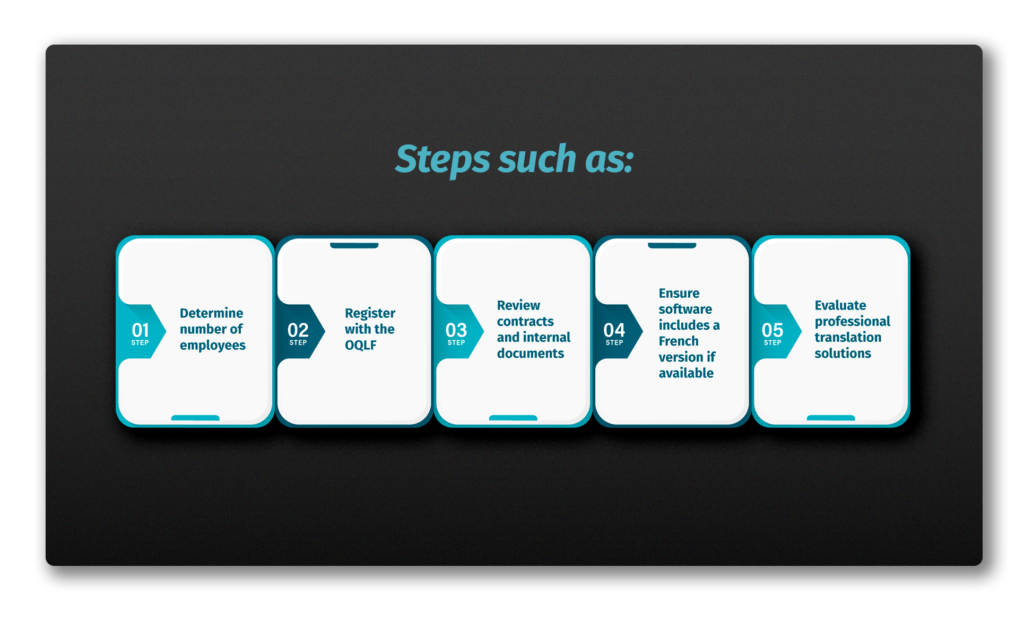
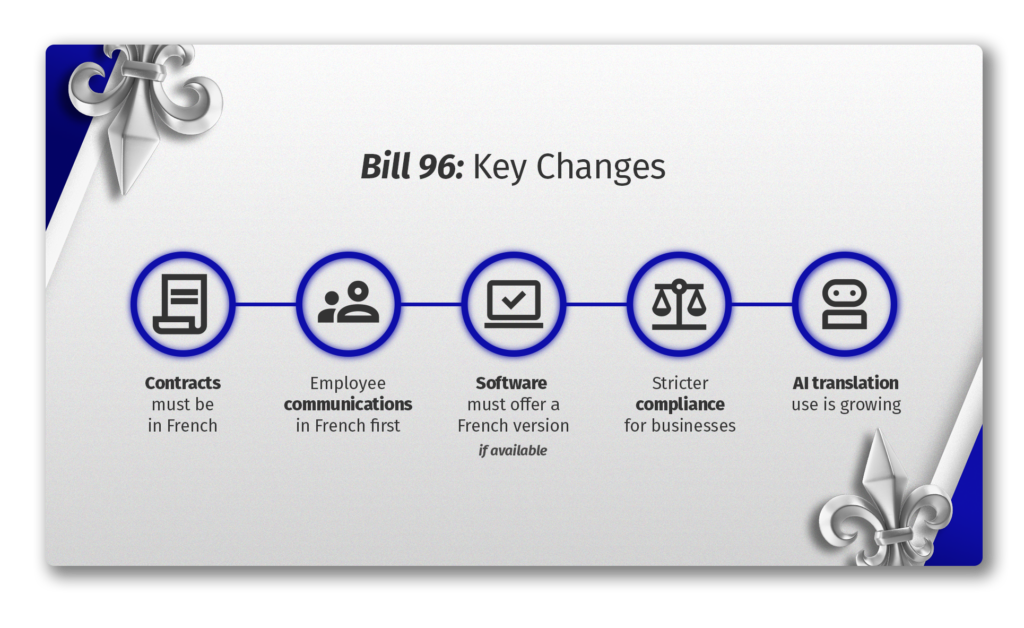
In its final form, the bill dictates that all written materials relating to operating a business in Quebec employing 50 or more employees must be made available in French.
This includes contracts, training documents, and all in-house communications within the organization
Changes and Clarifications: what you need to know
Among the most notable changes is that employment agreements must be provided to employees in French first. The same applies to all written communications to employees.
Da Silva advised that while you can respond in English to someone who communicates with you in English, it is worth offering them the option to communicate in French.
When it comes to filling roles that require an English speaker, it is also considered best practice to see if anyone within the organization already speaks English. Otherwise, your organization will have to conduct an assessment to determine whether speaking a language other than French is truly a job requirement.
Da Silva also raised that any organization registered in Quebec’s corporate registry as having between 5 and 49 employees must disclose the number of employees incapable of communicating in French.
Regarding internally used software, if the software being used has a French language option, it must be offered in French. However, if no French language option is available, there is no obligation to provide a French alternative. This does not apply to websites, which must still be available in French.
Stricter compliance guidelines: are you prepared?
If your organization has an average of 50 employees for more than 6 months, you will be obliged to register with the Office québécois de la langue française (OQLF) and complete a linguistics analysis form.
However, on June 1, 2025, this number will decrease to 25 employees.
Larose also mentioned that the exception of translating non-french branding and logos will only apply to registered trademarks. The trademark must include the name of the product as sold. Anything generic or descriptive must be translated into French.
New responsibilities for In-house Counsel
In-house counsel must ensure they accurately assess the number of employees capable of communicating in French when carrying out corporate filing responsibilities.
If the number changes, it should be reported as soon as possible.
The bill also has implications for contracts. A contract can only be made available in a non-French language if both parties agree to sign it in a different language after viewing the contract of adhesion.
Da Silva reinforced that the OQLF is here to assist in the compliance process and that counsel should seek their assistance to facilitate it.
AI will take an even greater role
André de Maurivez mentioned that many organizations are turning to built-in AI translation solutions within the software they already use to alleviate the added burden of compliance.
This raises additional concerns about the security and accuracy of these translations, especially when they are used to translate legal documents.
Da Silva noted that while these readily accessible translations might be suitable for informal communications, using them for legal documents would be inadvisable.
The need for a robust and nuanced translation solution
The panel also raised that organizations best poised for success might use Quebec French rather than the generic French found in more readily accessible translation solutions.
For example, some words will have an entirely different meaning if the Quebec-French translation is not used.
With so many new regulations to ensure compliance and the risks associated with failing to do so, the best course of action is a translation solution tailored to your organization’s requirements and Bill 96.
Stay Ahead of the Curve in 2025—and Beyond!
Don’t miss out on the knowledge that can help you stay competitive in 2025. Subscribe to our newsletter for exclusive insights into the latest financial trends, expert analysis, and more. Be the first to know—sign up today!
Are You Leveraging Fall to Prepare for Q1 Compliance? In Canada’s highly regulated financial services sector, the reporting cycle is defined by complexity, urgency, and constant change. Multilingual…
For decades, translation has largely been priced around one simple unit: the word. That made sense when the amount of content a translator could produce in a day…
AI can translate more content, faster than ever before. So translation should be getting simpler. It isn’t. As AI translation becomes more capable, organizations have more choices to…
To provide the best experiences, we use technologies like cookies to store and/or access device information. Consenting to these technologies will allow us to process data such as browsing behaviour or unique IDs on this site. Not consenting or withdrawing consent, may adversely affect certain features and functions.
Functional
Always active
The technical storage or access is strictly necessary for the legitimate purpose of enabling the use of a specific service explicitly requested by the subscriber or user, or for the sole purpose of carrying out the transmission of a communication over an electronic communications network.
Preferences
The technical storage or access is necessary for the legitimate purpose of storing preferences that are not requested by the subscriber or user.
Statistics
The technical storage or access that is used exclusively for statistical purposes.The technical storage or access that is used exclusively for anonymous statistical purposes. Without a subpoena, voluntary compliance on the part of your Internet Service Provider, or additional records from a third party, information stored or retrieved for this purpose alone cannot usually be used to identify you.
Marketing
The technical storage or access is required to create user profiles to send advertising, or to track the user on a website or across several websites for similar marketing purposes.