Les cinq principales raisons pour lesquelles l’automne est la
meilleure période pour choisir votre partenaire de traduction
en conformité réglementaire
Are You Leveraging Fall to Prepare for Q1 Compliance? In Canada’s highly regulated financial services sector, the reporting cycle is defined by complexity, urgency, and constant change.
EXPLORER DE NOUVELLES FRONTIÈRES : L’ÉVOLUTION DU RÔLE DES JURISTES D’ENTREPRISE EN 2024
Stefanie Neyland··
6 min. de lecture
En cette ère de possibilités sans précédent sur la scène internationale, des percées technologiques à l’évolution du milieu des affaires, le rôle des juristes d’entreprise n’a jamais été si enthousiasmant et important.
Le Global In-House Counsel de 2024, une enquête révolutionnaire menée par Mondaq et In-House Counsel Worldwide (ICW), offers an inspiring view of the profession’s current state and future trajectory, highlighting the innovative ways legal teams are adapting and thriving in this dynamic environment.
Grâce aux observations de près de 400 juristes d’entreprise répartis dans 60 pays, ce rapport est une mine d’information pour les professionnels du droit et les chefs d’entreprise. Il révèle une profession à l’avant-garde de l’innovation, qui adopte de nouvelles technologies et étend son influence au sein des organisations.
L’enquête dépeint les juristes d’entreprise comme des puissances stratégiques qui ne se limitent plus aux rôles juridiques traditionnels, mais qui façonnent activement les stratégies d’affaires et favorisent l’adoption de technologies.
From leveraging A.I. to reimagining risk management, today’s in-house legal teams are at the cutting edge of corporate evolution.
“The survey paints a picture of in-house counsel as strategic powerhouses, no longer confined to traditional legal roles but actively shaping business strategies and driving technological adoption.”
As we delve into the key findings, prepare to be inspired by the resilience, adaptability, and forward-thinking approach of the global in-house legal community. This report not only highlights the challenges faced by legal departments but also showcases the innovative solutions and opportunities they’re creating in response.
Join us as we explore how in-house counsel are not just navigating change—but actively leading it—positioning themselves as indispensable partners in business success. The future of in-house legal is bright, and this report is your window into the exciting developments shaping the profession.
Principaux points à retenir
The role of in-house counsel is evolving, requiring them to be business-savvy, tech-literate, and adaptable to changing landscapes.
A significant portion of legal departments anticipate budget growth, with technology being a primary investment area.
AI and generative AI are seen as key innovation areas, with many companies already leveraging these technologies for legal processes.
Despite expanding in-house capabilities, reliance on outside counsel remains strong, with many companies planning to increase their outsourcing budgets.
1. Le nouveau visage des services juridiques
“The best in-house lawyers today require so much more than legal skills,” the report emphatically states. This sentiment echoes throughout the findings, painting a picture of a profession in flux.
Gone are the days when legal expertise alone sufficed; today’s in-house counsel must be business-savvy, tech-literate, and adaptable to an ever-changing landscape.
One respondent, a General Counsel from a Fortune 500 company, remarked, “We’re no longer just legal advisors. We’re business partners, risk managers, and sometimes even tech innovators. It’s a challenging but exciting time to be in-house.”
“We’re no longer just legal advisors. We’re business partners, risk managers, and sometimes even tech innovators. It’s a challenging but exciting time to be in-house.”
2. Croissance budgétaire et priorités d’investissement
In a world where legal complexities are multiplying, it’s heartening to see that 38% of global legal departments expect budget growth. This financial optimism is particularly pronounced in certain regions.
“Almost two-thirds (65%) of Middle East & Africa and 47% of Latin America headquartered companies expect budgets to rise,” the report reveals. This regional disparity raises intriguing questions about the varying pressures and opportunities facing legal departments worldwide.
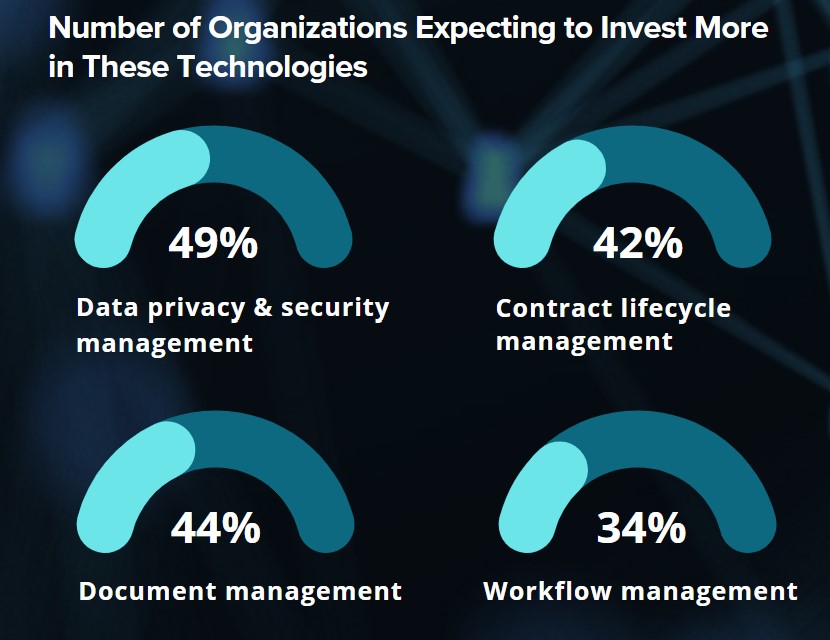
Mais où va cet argent? La réponse est claire : la technologie. Les deux tiers des entreprises du monde prévoient augmenter leurs investissements technologiques.
As one Chief Legal Officer put it, “We’re not just buying new software; we’re investing in our future ability to handle increasingly complex legal challenges efficiently.”
Principaux secteurs d’investissement des équipes juridiques :
Technologie : Environ les deux tiers des entreprises à l’échelle mondiale prévoient augmenter leurs investissements technologiques.
Dotation en personnel : 39 % des entreprises prévoient une croissance du budget destiné au personnel interne.
Juristes externes : 32 % des organisations prévoient consacrer plus d’argent à l’externalisation de services juridiques.
3. La révolution de l’IA dans le secteur juridique
Perhaps the most exciting—and potentially disruptive—trend highlighted in the report is the focus on Artificial Intelligence (A.I.) and Generative A.I. An impressive 44% of companies globally view this as their primary innovation area.
“A.I. isn’t just a buzzword for us,” shared a Senior Counsel from a tech giant. “It’s already transforming how we handle contract management, due diligence, and even some aspects of legal research. The potential is enormous.”
“Technology investment is a high priority, with 68% of organizations citing it as important and 62% expecting an increase in investment.”
Alors que 68 % des organisations soulignent l’importance des investissements technologiques et que 62 % s’attendent à une hausse des investissements, il n’est pas surprenant qu’ils soient une priorité élevée.
Principaux domaines d’investissement dans les technologies juridiques :
Intelligence artificielle (IA) et IA générative : 44 % des entreprises à l’échelle mondiale estiment que c’est le principal axe d’innovation.
Gestion des contrats : Le deuxième axe d’innovation en importance.
Numérisation (éliminer le papier) : C’est une priorité pour environ 1 entreprise sur 8 dans tous les secteurs et toutes les régions.
4. L’élément humain : Compétences et bien-être
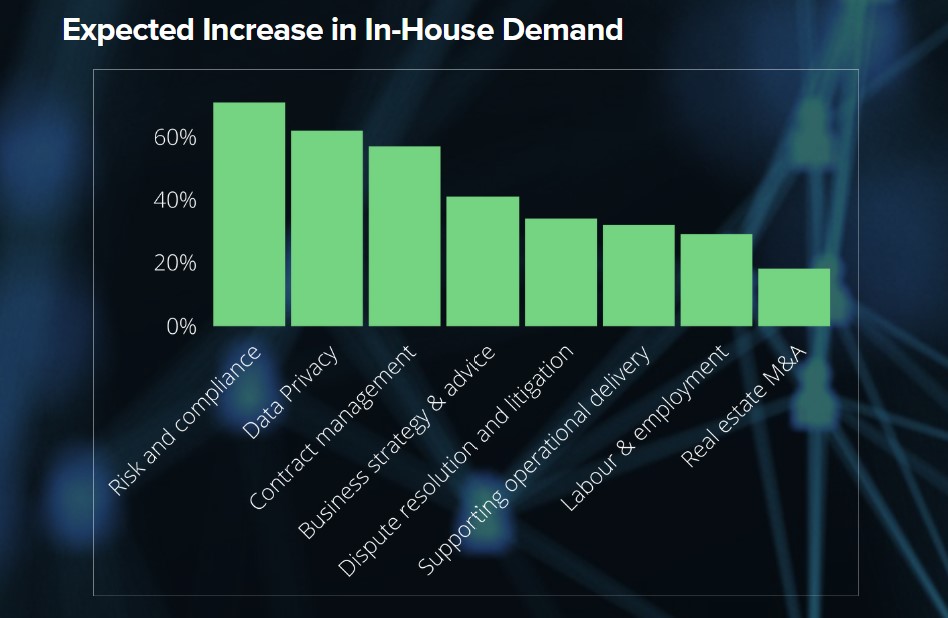
Amidst all this talk of technology and innovation, the report doesn’t lose sight of the human element. It emphasizes that understanding the business, flexibility, and the ability to give practical advice are now as crucial as legal expertise.
However, this expanded role comes at a cost. The report warns of “increasing levels of in-house demand, workload, and accountabilities,” raising alarm bells about a potential “employee wellbeing and mental health crisis” on the horizon.
“The pressure is immense. We’re expected to be legal experts, business strategists, and tech-savvy professionals all at once. It’s exciting, but it’s also exhausting.”
A mid-level counsel from a European firm shared, “The pressure is immense. We’re expected to be legal experts, business strategists, and tech-savvy professionals all at once. It’s exciting, but it’s also exhausting.”
L’évolution du travail juridique en entreprise exige que les juristes possèdent des compétences de plus en plus diversifiées. Les compétences clés sont les suivantes :
Compréhension de l’entreprise : oilà la principale exigence pour les juristes d’entreprise.
Flexibilité : La capacité de s’adapter à des circonstances et des exigences évolutives est essentielle.
Conseils pratiques : Les juristes d’entreprise doivent fournir des conseils pratiques et axés sur les affaires.
Expertise juridique : Bien qu’elle soit toujours importante, cette compétence est maintenant regroupée avec d’autres compétences clés.
Ces exigences reflètent l’influence et la portée croissantes des juristes d’entreprise au sein des organisations, alors que leurs rôles ont pris de l’ampleur et vont au-delà des responsabilités juridiques traditionnelles.
5. Le paradoxe de l’externalisation
Fait intéressant, malgré la croissance prévue des capacités internes, le recours aux juristes externes demeure élevé. Le rapport indique que 32 % des entreprises à l’échelle mondiale prévoient dépenser davantage pour confier des mandats à des juristes externes.
A Legal Operations Director explains this seeming paradox: “As our in-house responsibilities grow, we need to be strategic about what we handle internally and what we outsource. It’s about optimizing our resources, not just cutting costs.”
L’Amérique du Nord et l’Asie-Pacifique s’attendent à la plus forte augmentation de l’externalisation, tandis que l’Europe est la seule région où un plus grand nombre d’organisations s’attendent à réduire leurs dépenses plutôt qu’à les augmenter.
Conclusion : Une profession à la croisée des chemins
Le rapport Global In-House Counsel de 2024 brosse le tableau d’une profession à la croisée des chemins.
In-house legal departments are evolving rapidly, embracing technology, expanding their roles, and reimagining their work structures. However, this evolution brings its own set of challenges—particularly in terms of employee wellbeing and skill development.
As we look to the future, it’s clear that the most successful in-house legal teams will be those that can balance innovation with human-centric approaches. They’ll leverage A.I. and other technologies while nurturing a skilled, adaptable, and resilient workforce.
One thing is certain: the role of in-house counsel is more vital and more complex than ever before. As one General Counsel aptly put it, “We’re not just navigating legal waters anymore. We’re charting the course for our entire organizations in a sea of unprecedented change.”
The 2024 Global In-House Counsel Report isn’t just a survey; it’s a roadmap for the future of legal departments worldwide. For those willing to embrace change, the opportunities are boundless.
Pour en savoir plus sur l’avenir du droit interne
Ce billet de blogue n’a fait qu’effleurer la surface de la mine d’information que l’on retrouve dans le rapport Global In-House Counsel de 2024. Pour bien comprendre les changements sismiques qui transforment le paysage juridique, il vous faut une image complète.
Téléchargez le rapport complet à l’adresse suivante :
Découvrez des analyses régionales détaillées qui pourraient avoir un impact sur votre stratégie globale;
Accédez à des citations exclusives et à des conseils de grands avocats généraux;
Explorer les données détaillées sur les tendances et les obstacles en matière d’adoption de la technologie;
Obtenez un avantage concurrentiel grâce à des recommandations concrètes pour votre service juridique.
Don’t miss out on this invaluable resource—click below to download your free copy of the report and position your legal department for success in 2024 and beyond.
Are You Leveraging Fall to Prepare for Q1 Compliance? In Canada’s highly regulated financial services sector, the reporting cycle is defined by complexity, urgency, and constant change. Multilingual…
Depuis des décennies, le prix de la traduction repose en grande partie sur une donnée toute simple : le nombre de mots.
Ce modèle se justifiait tant que la production quotidienne d’un traducteur imposait une limite naturelle à la capacité.
L’IA permet de traduire plus de contenu, plus vite que jamais.
C’est donc plus facile?
Non.
Face à la montée en puissance de la traduction alimentée par l’IA, les entreprises se retrouvent à devoir pr
Pour vous offrir la meilleure expérience
possible, nous utilisons des technologies
comme les témoins pour stocker des
informations sur votre appareil ou
accéder à celles-ci. Votre consentement
à l’utilisation de ces technologies nous
permettra de traiter certaines données,
comme vos tendances en matière de
navigation, et de vous attribuer un
identifiant unique sur ce site. L’absence
ou le retrait du consentement peut
entraver certaines fonctionnalités du site.
Fonctionnels
Toujours activé
Le stockage ou l’accès technique est strictement nécessaire aux fins légitimes d’utilisation d’un service en particulier demandé expressément par l’abonné ou l’utilisateur, ou aux seules fins de transmission d’une communication sur un réseau de communications électronique.
Préférentiels
Le stockage ou l’accès technique est utilisé à des fins légitimes de conservation des préférences non demandées par l’abonné ou l’utilisateur.
Statistiques
Le stockage ou l’accès technique utilisé exclusivement à des fins statistiques.Le stockage ou l’accès technique utilisé exclusivement pour la production de statistiques anonymes. Sans assignation à comparaître, consentement volontaire de votre fournisseur de services Internet ou informations supplémentaires d’un tiers, les renseignements stockés ou récupérés à cette seule fin ne peuvent généralement pas être utilisés pour vous identifier.
Commercialisation
Le stockage ou l’accès technique est requis pour créer des profils d’utilisateurs à des fins de publicité ou pour suivre l’activité d’un utilisateur sur un ou plusieurs sites Web à des fins de marketing similaires.