Top 5 Reasons Fall Is Key to Choosing Your Compliance Translation Partner
Are You Leveraging Fall to Prepare for Q1 Compliance? In Canada’s highly regulated financial services sector, the reporting cycle is defined by complexity, urgency, and constant change.
5 Signs Your Financial Reporting Workflow Needs a Redesign
Christine Clay··
4 min read
Financial reporting has become more complex. More stakeholders. More systems. More pressure to move quickly.
And yet, many organizations are still relying on workflows that weren’t built for today’s reporting demands, particularly when high-stakes content must move across languages, teams, and review cycles.
60% of Canadian financial leaders say time spent on tedious manual processes inhibits their work on strategic projects.1
The problem isn’t always obvious.
A deadline is met. A report is filed. The process moves on.
Until the pressure builds.
Table of Contents
The Warning Signs Are Easy to Miss
Most workflow problems don’t begin with a missed deadline.
They build quietly.
An approval takes longer than expected. A reviewer becomes a bottleneck. A translated version falls out of sync after a late-stage change. A late request forces teams to reshuffle priorities.
Individually, each issue feels manageable.
Together, they point to something bigger.
A workflow that depends on workarounds, institutional knowledge, and last-minute intervention may still deliver. But as reporting volumes increase and timelines tighten, the cracks become harder to contain.
That’s when a process problem becomes an operational risk.
Where Reporting Workflows Start to Break
1. Bottlenecks Keep Appearing in the Same Places
One person holds up every approval. A handoff between teams repeatedly stalls progress. A single delay creates pressure across everything that follows.
When the same bottlenecks appear cycle after cycle, the issue is rarely the individual request.
It’s the workflow.
2. Version Control Is Becoming Harder to Manage
Multiple files circulate across teams. Source content changes while multilingual versions are already in review. Edits arrive through different channels. Reviewers work from outdated versions.
The result is more than confusion.
It creates rework, slows approvals, and increases the risk that inconsistent content reaches the final document.
3. Reviewers Are Becoming a Constraint
Specialized reviewers are essential to high-stakes financial communication. But when too much work depends on too few people, expertise becomes a bottleneck.
Reviews pile up.
Turnaround times stretch.
High-value experts spend more time correcting preventable issues than applying judgment where it matters most.
4. Last-Minute Requests Disrupt Everything Else
Unexpected requests are inevitable.
A workflow that can absorb them is not.
When one urgent request forces teams to delay other priorities, add manual handoffs, or compress review cycles, the process lacks the flexibility to adapt under pressure.
5. Manual Coordination Is Holding the Process Together
Status updates live in email. Teams chase approvals. Someone has to remember which version is final, who still needs to review it, what has been sent to external partners, and what happens next.
The workflow works because people keep it working.
That’s the warning sign.
A process that depends on constant manual intervention becomes harder to scale, harder to govern, and more vulnerable as complexity increases.
What Stronger Workflows Do Differently
A stronger financial reporting workflow creates the structure to manage complexity.
Roles are clear before deadlines approach. Review and approval responsibilities are defined. Terminology remains consistent across languages, financial reports, board materials, proxy circulars, and other high-stakes documents.
Technology reduces unnecessary manual effort. Professional expertise stays focused where judgment, context, and accountability matter most.
And when reporting volumes increase, the workflow can scale without sacrificing consistency or control.
The goal is to create a process that can adapt without breaking under pressure.
From Fixing Problems to Building Long-Term Readiness
The strongest workflows do more than solve today’s bottlenecks.
They improve over time.
As organizational context accumulates, terminology becomes more consistent. Processes become more aligned to how teams actually work. Technology can reduce manual effort, while professional expertise provides the judgment and oversight high-stakes financial communication demands.
That’s where the right partner makes a difference.
Apertera (formerly Alexa Translations) combines advanced AI technology with more than two decades of professional expertise to help leading financial institutions manage high-stakes multilingual content across complex reporting workflows. By working as an extension of your team, we build deeper understanding of your standards, workflows, and organizational context over time.
More continuity. More alignment. Greater confidence when reporting pressure builds.
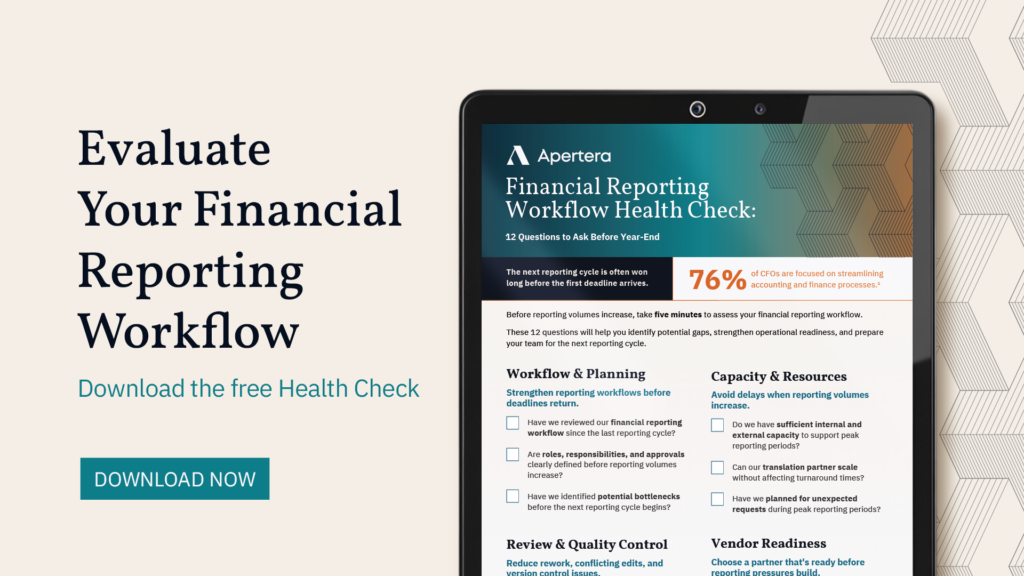
Want to Know Where Your Workflow Stands? Download the Financial Reporting Workflow Health Check: 12 Questions to Ask Before Year-End to assess your current process, identify potential gaps, and determine where your workflow may need strengthening.
1. How do you know when a financial reporting workflow needs to be redesigned? Common warning signs include recurring bottlenecks, version control issues, reviewer overload, frequent last-minute disruptions, and heavy reliance on manual coordination. If the same problems return each reporting cycle, the workflow may no longer support current demands.
2. What makes a financial reporting workflow more effective? Effective workflows combine clear roles and approval responsibilities, consistent terminology, scalable processes, and technology that reduces unnecessary manual effort. For high-stakes multilingual content, professional expertise also helps ensure context, accuracy, and accountability are maintained as reporting demands increase.
3. How can Corporate Secretaries improve coordination across complex reporting and approval workflows? Corporate Secretaries often coordinate input across legal, finance, executives, and external partners. Clear ownership, defined review sequences, and centralized version control can help keep board materials, proxy circulars, and other high-stakes documents aligned as they move through multiple stakeholders and approval cycles.
Are You Leveraging Fall to Prepare for Q1 Compliance? In Canada’s highly regulated financial services sector, the reporting cycle is defined by complexity, urgency, and constant change. Multilingual…
For decades, translation has largely been priced around one simple unit: the word. That made sense when the amount of content a translator could produce in a day…
AI can translate more content, faster than ever before. So translation should be getting simpler. It isn’t. As AI translation becomes more capable, organizations have more choices to…
To provide the best experiences, we use technologies like cookies to store and/or access device information. Consenting to these technologies will allow us to process data such as browsing behaviour or unique IDs on this site. Not consenting or withdrawing consent, may adversely affect certain features and functions.
Functional
Always active
The technical storage or access is strictly necessary for the legitimate purpose of enabling the use of a specific service explicitly requested by the subscriber or user, or for the sole purpose of carrying out the transmission of a communication over an electronic communications network.
Preferences
The technical storage or access is necessary for the legitimate purpose of storing preferences that are not requested by the subscriber or user.
Statistics
The technical storage or access that is used exclusively for statistical purposes.The technical storage or access that is used exclusively for anonymous statistical purposes. Without a subpoena, voluntary compliance on the part of your Internet Service Provider, or additional records from a third party, information stored or retrieved for this purpose alone cannot usually be used to identify you.
Marketing
The technical storage or access is required to create user profiles to send advertising, or to track the user on a website or across several websites for similar marketing purposes.